Welcome!
By registering with us, you'll be able to discuss, share and private message with other members of our community.
SignUp Now!You are using an out of date browser. It may not display this or other websites correctly.
You should upgrade or use an alternative browser.
You should upgrade or use an alternative browser.
Sad news
- Thread starter Jimi
- Start date
More options
Who Replied?
OP
OP

- Joined
- Feb 9, 2025
- Messages
- 6,149
Offline


You didn’t miss it. That little phrase at the bottom of the M&Ms bag you just bought? It’s not a suggestion. It’s the new legal reality.

Manufacturers use bioengineered (BE) ingredients—like genetically modified corn starch or sugar—primarily to cut costs, boost crop yields, and ensure supply chain stability. They’re functional choices, not quality upgrades.

Before 2022, these were called GMOs. The USDA created the "Bioengineered" standard to replace a confusing mix of state laws. It defines food that contains genetic material modified through lab techniques that can't be found in nature.

While the U.S. now requires this disclosure under 7 CFR Part 66, other regions have far stricter rules. The European Union, for example, demands mandatory GMO labeling for products with more than 0.9% pre-approved genetically modified content. If a GM variety isn't authorized, it’s banned outright.

The USDA standard is explicitly a marketing standard, not a food safety one. Major health organizations like the FDA, AMA, and WHO state that currently approved BE foods are safe for consumption, but they acknowledge public desire for transparency.

If you want to avoid BE ingredients, you must read labels carefully. Look for voluntary "Non-GMO Project Verified" seals.

• AVOID: "Contains Bioengineered Food Ingredients"
• LOOK FOR: USDA Organic (automatically exempt from BE disclosure), Non-GMO Project Verified


1. USDA Agricultural Marketing Service (AMS), "National Bioengineered Food Disclosure Standard (7 CFR Part 66)," 2022.
2. European Parliament and Council, "Regulation (EC) No 1829/2003 on genetically modified food and feed," 2003.
3. FDA, "Feed Your Mind: GMO Foods and Your Health," 2024.

#AJKoby #FoodChemistry #MMs #GMO


OP
OP
- Joined
- Feb 9, 2025
- Messages
- 6,149
Offline
I've posted many times about the dangers of the petroleum-created, cancer-causing food dyes that have been so prevalent in our foods, and the diseases they cause.
So happy they will soon be banned in the United States, just as they are in so many other countries!
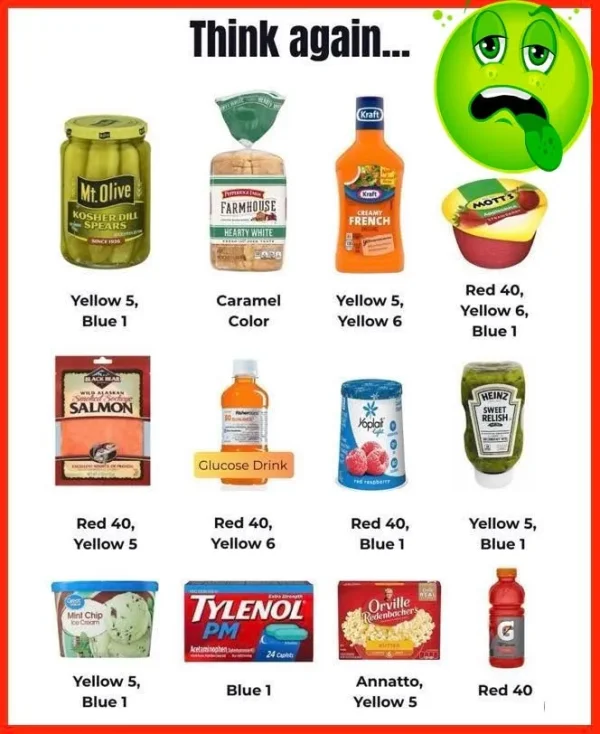
So happy they will soon be banned in the United States, just as they are in so many other countries!
OP
OP
- Joined
- Feb 9, 2025
- Messages
- 6,149
Offline
Florida’s Department of Health tested 46 of America’s most popular Halloween candies. Arsenic was detected in 28 of them — 60%. Kit Kat. Snickers. Twizzlers. Tootsie Rolls. Nerds. Skittles. SweeTarts. Sour Patch Kids. Jolly Ranchers. Trolli. Swedish Fish. Laffy Taffy. All positive for arsenic. Tonight, tens of millions of children will collect bags full of them. None of the wrappers will mention heavy metals. None of the parents will know.


OP
OP
- Joined
- Feb 9, 2025
- Messages
- 6,149
Offline
Potassium bromate is a powerful oxidizing agent widely baked into American bread to artificially strengthen dough, accelerate baking times, and yield
a fluffier, high-rising loaf. However, this convenience comes with an alarming dark side: decades of scientific research have linked the additive to kidney and thyroid tumors in laboratory rats, prompting the World Health Organization to classify it as a genotoxic carcinogen that can damage DNA at any dose. While the European Union, the United Kingdom, Canada, China, and numerous other nations have strictly banned its use out of public safety concerns, the U.S. Food and Drug Administration (FDA) still permits it federally under grandfathered safety clauses. Adding to the consumer challenge, this toxic additive rarely announces itself clearly on supermarket shelves; it frequently hides in plain sight under alternative names on ingredient labels, most commonly disguised as “Bromated flour”or “enriched Bromated flour”. To actively avoid potassium bromate, look for front-of-package claims or ingredient lines that explicitly say “unbromated flour”, “bromate free” or “no bromate”.

a fluffier, high-rising loaf. However, this convenience comes with an alarming dark side: decades of scientific research have linked the additive to kidney and thyroid tumors in laboratory rats, prompting the World Health Organization to classify it as a genotoxic carcinogen that can damage DNA at any dose. While the European Union, the United Kingdom, Canada, China, and numerous other nations have strictly banned its use out of public safety concerns, the U.S. Food and Drug Administration (FDA) still permits it federally under grandfathered safety clauses. Adding to the consumer challenge, this toxic additive rarely announces itself clearly on supermarket shelves; it frequently hides in plain sight under alternative names on ingredient labels, most commonly disguised as “Bromated flour”or “enriched Bromated flour”. To actively avoid potassium bromate, look for front-of-package claims or ingredient lines that explicitly say “unbromated flour”, “bromate free” or “no bromate”.


Users who are viewing this thread
Total: 2 (members: 0, guests: 2)
Online statistics
- Members online
- 2
- Guests online
- 130
- Total visitors
- 132
- Robots
- 183
Totals may include hidden visitors.
Trending content
-
 Thread 'Music Game - Keep a word, drop a word from the song title or artist name'
- gopher_byrd
Replies: 3K -

-
-
-


