Welcome!
By registering with us, you'll be able to discuss, share and private message with other members of our community.
SignUp Now!You are using an out of date browser. It may not display this or other websites correctly.
You should upgrade or use an alternative browser.
You should upgrade or use an alternative browser.
What are you havin for dinner?
- Thread starter Jimi
- Start date
More options
Who Replied?

OP
OP

- Joined
- Feb 9, 2025
- Messages
- 4,386
Offline
The calories on your food label aren’t the whole story
When you read the calorie count on a food label, do you assume that’s exactly what your body takes in?I did, for years.
A new study suggests that isn’t quite true.
Researchers at Arizona State University have built a mathematical model, called DAMM, that follows food all the way through the highways and byways of your digestive tract. It estimates how much energy your body absorbs early on. And how much your gut bacteria add from whatever is left over.
That second part never makes it onto the label.
The calorie numbers on packaging come from a system more than 100 years old. Each gram of fat, carbohydrate, and protein gets an average calorie value, and the total is added up. It's simple, and it's useful. But it doesn't ask what happens to the food that reaches your colon, or what your gut bacteria do with it.
And they do quite a lot.
Fiber and resistant starch that your own digestion can't break down get fermented by gut bacteria into short-chain fatty acids. Some of those are absorbed into your bloodstream and used as energy.
According to the model, that adds up to about 140 calories a day. Roughly 7% of the usable energy in the diet came from what your gut bacteria made out of the food you couldn't digest yourself.
When the researchers tested the model against real measurements from a controlled feeding study, it came closer than the traditional calorie method.
This is the part I found most interesting.
In that earlier study, healthy adults ate either a high-fiber, less processed diet or a typical Western-style diet. The people on the Western diet absorbed about 116 more calories a day.
And the people eating all that extra fiber didn't report feeling any hungrier.
Which seems backwards at first.
The high-fiber diet gave their gut bacteria far more to work with, and they made more short-chain fatty acids. Yet overall, those people absorbed fewer calories. The upper gut took in less, and the microbes didn't fully make up the difference.
A few caveats are worth knowing. DAMM is a research model, not a diet plan. It was tested against one small study of 17 healthy adults, and the authors say it needs testing in more people, including those with metabolic conditions, before anyone uses it to tailor diets. And, I will add, 116 calories a day isn't a weight-loss strategy I know!
But what it does show is something I keep coming back to: Your food provides the raw materials. Your gut bacteria decide what happens next.
Which means fiber-rich, less processed foods aren't just "good for you" in some vague way. They're feeding a community of microbes that is doing real work on your behalf.
So, the next time you glance at a calorie label, remember it's only half the story. The other half is happening in your gut.
Yours for better health, naturally,


- Joined
- Feb 8, 2025
- Messages
- 491
Offline
Here comes Thanksgiving, and my mind is still on that conversation with my niece a few years back, when I explained to her that nobody has to buy, prep, roast or carry the big bird anymore for our gatherings, since all the old folks are gone, and how we do things very casually now: tamales, salsa, guacamole, a traditional sweet potato dish, rice with flavorful additions, gravy if anybody wants to make it, beer and pumpkin ale, wine, iced tea, and desserts. The tamales, being in a masa shell, are their own dressing.
She was not up to date on what are now our established routines for quite a few years, because she doesn't live here in SA. She's in a town outside of Houston, so she isn't always here for holidays. We are looking forward to seeing her this year. So I'm remembering how she was a little crestfallen upon learning of our new casual ways, remembering aloud how you'd smell that roasting bird with the sage even outside the front door, before going in.
When I found out she was coming, I volunteered to have Thanksgiving here. Though I don't think it's my turn, nobody else has mentioned it. I want to bring back traditional Thanksgiving for my niece, but not the whole big bird. I want to make turkey wings and dressing. It's been so long, I'm having a hard time remembering how I used to make dressing. Cooking the stuffing inside the bird was not considered optimal. I remember these things:
A sheet of cornbread (so my shopping list includes a package of cornbread mix or a store made cornbread)
Chopped onion and celery, sauteed in bird fat, after the turkey was cooked and drippings available.
Salt and pepper
Sage was already cooked in the bird
So you crumbled up the cornbread, mixed in the sauteed onion and celery. Did you add an egg? I don't remember doing that. Then you patted out your mixture in a pan and baked it right before dinner, uncovered, to get the top crispy. While it was baking you made your gravy with turkey drippings. Hopefully the wings will make enough drippings for gravy.
Am I missing anything? I also have a bouillon cubes here in case I need to add more moisture to the dressing before baking, if the wings don't make enough juice.
A friend of mine makes two turkeys at Thanksgiving. She says one for the turkey and one for the dressing. Hmmm. I'll be doing a trial run of the wings before the holiday, so maybe I can save some juice and fat from that and chuck them in the freezer.

- Joined
- Feb 9, 2025
- Messages
- 1,315
Offline
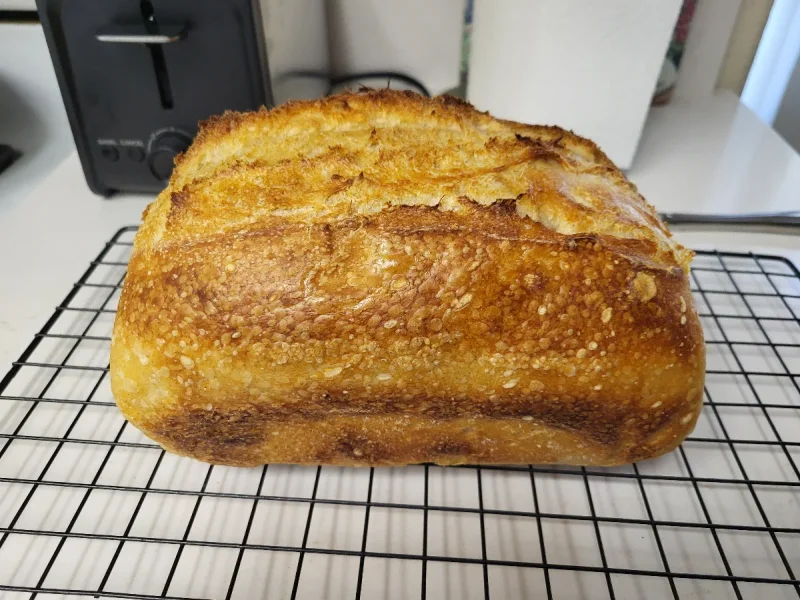
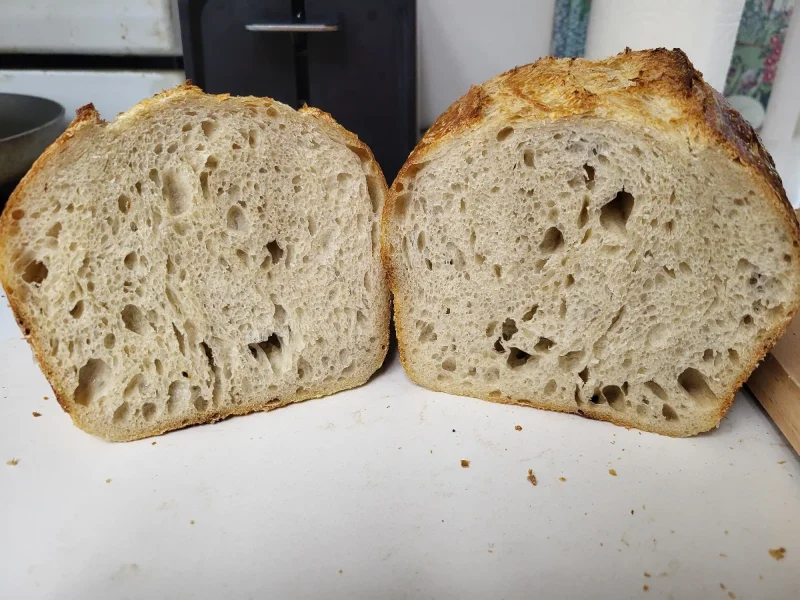


- Joined
- Feb 8, 2025
- Messages
- 491
Offline
I did my turkey wings trial run tonight, so I could be sure of what's just right and what doesn't work when the real time comes.
I believe sage is the signature ingredient in holiday turkey and dressing. The aroma is unmistakable. The one thing I know does not belong on turkey is garlic. Some people may include it, not my genetic line, and my forebears were not afraid of strong seasonings. They made homemade chili with garlic, cumin, Mexican oregano, chile pulp and other spices, simmered a long time into the beef, and that chili was used in homemade enchiladas. So understand, we're not squeamish about seasonings. Garlic simply does not belong in turkey. So here is what I did:
Spread out the finely chopped onion, celery and fresh sage, rosemary and thyme in the pan, added salt and pepper, and a little water to cover the veg., just to keep the bottom of the pan moist before the bird juices could get flowing. The top of the pan roasts in the hot oven air.
Rubbed down the wings with more fresh herbs, salt and pepper. Added the prepped wings to the pan, over the veg. Pan went into the oven at 400 degrees. Turkey wings are big, nothing like dinky chicken wings. Three of them fit in my biggest pan, so on the holiday, or maybe the day before, I'll make three pans so each person gets a whole wing with dressing. That's a big plate, but I'll still get the tamales, pico de gallo and guac for those who will be relishing the thought of those. Someone else will be responsible for sweet potatoes, rice and other goodies. I just want to surprise my nostalgic niece with that old familiar smell of roasting bird and sage when she comes to the door.
So when the wings were done and browned on top, I removed them to a clean pan, turned them over to cook the undersides which were still a bit flabby. While those were cooking, I crumbled up the store made cornbread I bought, and added the cooked onion and celery from the hot pan. I made the gravy, knowing I would want some of it for the cornbread dressing. I left the dressing kind of chunky.
While it baked alongside the finishing wings, I made gravy in the original pan, which still had a lot of juice and fat. It didn't make enough gravy even for three plates, so that's a lesson learned. A cousin told me that if you're not cooking a whole bird, you can cook a turkey thigh or two separately, even on top of the stove, to have enough birdness for gravy for everyone.
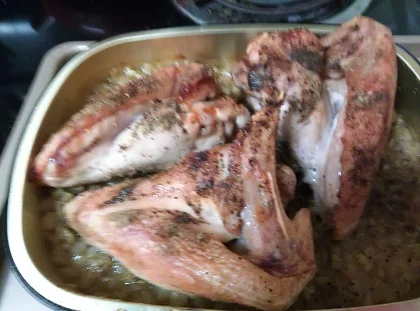
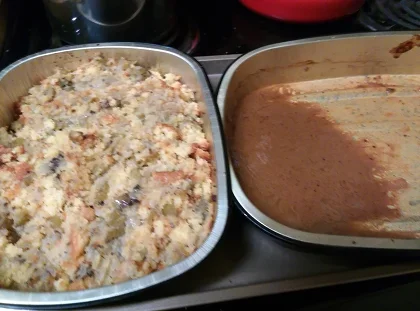
This pic is before I browned the dressing in the oven. I wanted to show it next to how little gravy I was able to make from what bird juice was left after I added some drippings to the dressing:
My plate:
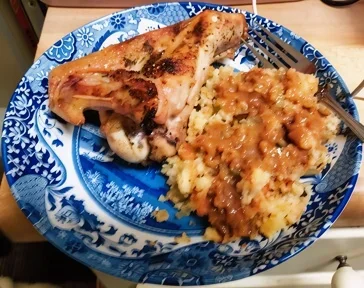
I can tell you that's a lot of food. You can't tell how big that wing actually is, being turned in on itself. At least 15 bites of juicy meat, lots of crispy skin. One wing is about equivalent to the amount you would have put on your plate from the whole bird, back in the day, even more than I ever served myself.
I believe sage is the signature ingredient in holiday turkey and dressing. The aroma is unmistakable. The one thing I know does not belong on turkey is garlic. Some people may include it, not my genetic line, and my forebears were not afraid of strong seasonings. They made homemade chili with garlic, cumin, Mexican oregano, chile pulp and other spices, simmered a long time into the beef, and that chili was used in homemade enchiladas. So understand, we're not squeamish about seasonings. Garlic simply does not belong in turkey. So here is what I did:
Spread out the finely chopped onion, celery and fresh sage, rosemary and thyme in the pan, added salt and pepper, and a little water to cover the veg., just to keep the bottom of the pan moist before the bird juices could get flowing. The top of the pan roasts in the hot oven air.
Rubbed down the wings with more fresh herbs, salt and pepper. Added the prepped wings to the pan, over the veg. Pan went into the oven at 400 degrees. Turkey wings are big, nothing like dinky chicken wings. Three of them fit in my biggest pan, so on the holiday, or maybe the day before, I'll make three pans so each person gets a whole wing with dressing. That's a big plate, but I'll still get the tamales, pico de gallo and guac for those who will be relishing the thought of those. Someone else will be responsible for sweet potatoes, rice and other goodies. I just want to surprise my nostalgic niece with that old familiar smell of roasting bird and sage when she comes to the door.
So when the wings were done and browned on top, I removed them to a clean pan, turned them over to cook the undersides which were still a bit flabby. While those were cooking, I crumbled up the store made cornbread I bought, and added the cooked onion and celery from the hot pan. I made the gravy, knowing I would want some of it for the cornbread dressing. I left the dressing kind of chunky.
While it baked alongside the finishing wings, I made gravy in the original pan, which still had a lot of juice and fat. It didn't make enough gravy even for three plates, so that's a lesson learned. A cousin told me that if you're not cooking a whole bird, you can cook a turkey thigh or two separately, even on top of the stove, to have enough birdness for gravy for everyone.
This pic is before I browned the dressing in the oven. I wanted to show it next to how little gravy I was able to make from what bird juice was left after I added some drippings to the dressing:
My plate:
I can tell you that's a lot of food. You can't tell how big that wing actually is, being turned in on itself. At least 15 bites of juicy meat, lots of crispy skin. One wing is about equivalent to the amount you would have put on your plate from the whole bird, back in the day, even more than I ever served myself.
Last edited:
OP
OP
- Joined
- Feb 9, 2025
- Messages
- 4,386
Offline
I did my turkey wings trial run tonight, so I could be sure of what's just right and what doesn't work when the real time comes.
I believe sage is the signature ingredient in holiday turkey and dressing. The aroma is unmistakable. The one thing I know does not belong on turkey is garlic. Some people may include it, not my genetic line, and my forebears were not afraid of strong seasonings. They made homemade chili with garlic, cumin, Mexican oregano, chile pulp and other spices, simmered a long time into the beef, and that chili was used in homemade enchiladas. So understand, we're not squeamish about seasonings. Garlic simply does not belong in turkey. So here is what I did:
Spread out the finely chopped onion, celery and fresh sage, rosemary and thyme in the pan, added salt and pepper, and a little water to cover the veg., just to keep the bottom of the pan moist before the bird juices could get flowing. The top of the pan roasts in the hot oven air.
Rubbed down the wings with more fresh herbs, salt and pepper. Added the prepped wings to the pan, over the veg. Pan went into the oven at 400 degrees. Turkey wings are big, nothing like dinky chicken wings. Three of them fit in my biggest pan, so on the holiday, or maybe the day before, I'll make three pans so each person gets a whole wing with dressing. That's a big plate, but I'll still get the tamales, pico de gallo and guac for those who will be relishing the thought of those. Someone else will be responsible for sweet potatoes, rice and other goodies. I just want to surprise my nostalgic niece with that old familiar smell of roasting bird and sage when she comes to the door.
So when the wings were done and browned on top, I removed them to a clean pan, turned them over to cook the undersides which were still a bit flabby. While those were cooking, I crumbled up the store made cornbread I bought, and added the cooked onion and celery from the hot pan. I made the gravy, knowing I would want some of it for the cornbread dressing. I left the dressing kind of chunky.
While it baked alongside the finishing wings, I made gravy in the original pan, which still had a lot of juice and fat. It didn't make enough gravy even for three plates, so that's a lesson learned. A cousin told me that if you're not cooking a whole bird, you can cook a turkey thigh or two separately, even on top of the stove, to have enough birdness for gravy for everyone.
View attachment 2053
View attachment 2051
View attachment 2050
This really looks so delicious, I am a turkey addict anyway and love all the Thanksgivin trimmins that I can't have anymore. I miss dressin with oysters in it
- Joined
- Feb 8, 2025
- Messages
- 491
Offline
This really looks so delicious, I am a turkey addict anyway and love all the Thanksgivin trimmins that I can't have anymore. I miss dressin with oysters in it
Mmm oysters. We never had those in the dressing, but my uncle always made a creamy, herby oyster stew for New Years Day. I'm a little bit allergic to shellfish, sometimes. After I found that out the hard way, I dipped the soup from around the oysters and left them behind.
"0 Oysters, come and walk with us!"
The Walrus did beseech.
"A pleasant walk, a pleasant talk,
Along the briny beach:
We cannot do with more than four,
To give a hand to each."
"But wait a bit," the Oysters cried,
"Before we have our chat;
For some of us are out of breath,
And all of us are fat!"
"No hurry!" said the Carpenter.
They thanked him much for that.
"A loaf of bread," the Walrus said,
"Is what we chiefly need:
Pepper and vinegar besides
Are very good indeed—
Now, if you're ready, Oysters dear,
We can begin to feed."
"But not on us!" the Oysters cried,
Turning a little blue.
"After such kindness, that would be
A dismal thing to do!"
"The night is fine," the Walrus said,
"Do you admire the view?
"0 Oysters," said the Carpenter,
"You've had a pleasant run!
Shall we be trotting home again?"
But answer came there none—
And this was scarcely odd, because
They'd eaten every one.
Last edited:
- Joined
- Feb 8, 2025
- Messages
- 491
Offline
I'd love to be able to have a Thanksgivin dinner like I usedto
If you can get a fresh turkey from a local seller, a package of organic cornbread mix, organic sweet potatoes with organic pineapple juice and pecans, some of your garden green beans, you can come close. You need some starch to make the drippings into gravy, but Lydia Bastianich once said that if you don't have any flour or cornstarch, you can grate some bread into very fine crumbs, and that will work. Then strain out the crumbs. So if you have some organic sourdough you can use some of that to thicken your gravy.
I don't know about the oysters. Those are filters for ocean pollution.
Bon Appetit Jimi. I wish you a holiday of abundance, for celebrating thankfulness.
Last edited:
Users who are viewing this thread
Total: 2 (members: 1, guests: 1)
Online statistics
- Members online
- 2
- Guests online
- 60
- Total visitors
- 62
- Robots
- 206
Totals may include hidden visitors.
Trending content
-
 Thread 'Music Game - Keep a word, drop a word from the song title or artist name'
- gopher_byrd
Replies: 2K -

-

-

-


